
What does a month of working from cafés in Bangkok really cost?
Build a realistic monthly Bangkok café-work budget with drinks, food, BTS/MRT, mobile data, backups and three example schedules.
Quick answer
Count the whole day: drinks, meals you would not otherwise buy, transport, mobile data and occasional room bookings. Your actual number of café days matters more than a single average coffee price. The examples below are budgeting scenarios, not current menu quotes.
Example calculation: 20 café-work days
| Cost item | Example assumption | Monthly total (THB) |
|---|---|---|
| Drinks | 2 × 100 × 20 | 4,000 |
| Meals | 150 × 20 | 3,000 |
| Return transport | 80 × 20 | 1,600 |
| Subtotal | 200 + 150 + 80 = 430/day | 8,600 |
Illustrative arithmetic only, not researched menu prices or rail fares. Replace every assumption with your receipts. Add mobile data, equipment and booked rooms; subtract meals you would buy anyway when estimating the extra cost of café work.
1. Start with a transparent monthly model
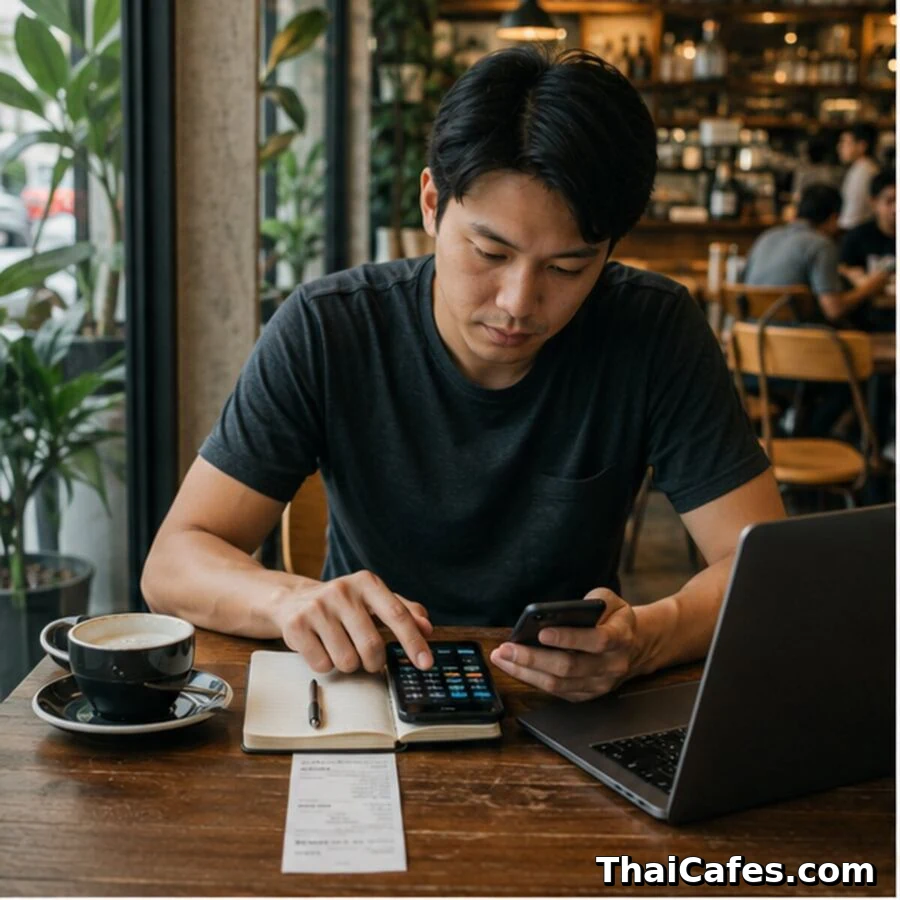
A café day can feel inexpensive until it becomes your routine. One extra drink, a ride from the station and lunch bought because you stayed longer can change the total. Start with last week's spending if you have it. Separate costs you would have paid anyway from costs caused by working in cafés. That gives you a useful monthly estimate without pretending everyone in Bangkok has the same habits.
For planning only, use a drink range of 80–160 baht and a simple meal range of 120–300 baht, then replace each with prices from venues you will actually use. Specialty coffee, hotel cafés, premium malls and imported food can sit above those ranges; local drinks and simple meals may sit below. Add a second order for sessions longer than two or three hours. A worker who buys one drink for a forty-five-minute session has a different budget and relationship with the venue from someone occupying a dining table through lunch.
Track cost per productive hour, not cost per visit. A 140-baht drink during three completed hours is efficient; a cheaper order followed by unstable Wi-Fi, a venue change and no finished work is expensive. Record arrival time, productive minutes, orders, transport and whether a backup was needed. After ten sessions, divide total spend by completed work hours. This metric reveals whether a premium but reliable café, a coworking pass or a home-and-café hybrid produces better value for your particular job.
Choose a few real places in the Café Finder, then check their current menus and routes. Around Ari, compare a short visit at The Coffee Zelection with a longer session at Poet House Cafe; this is a comparison of your needs, not a claim that one has a cheaper menu. The café versus coworking guide helps when frequent café purchases start approaching a workspace budget.
2. Three example café-work budgets
A light twelve-day plan might use cafés three times a week for ninety-minute sessions. At one 120-baht average drink per visit, orders total 1,440 baht before transport. Add return rail journeys based on your real route, perhaps occasional water or food, and a mobile-data plan. This pattern suits people with a good home desk who use cafés for variety, planning or a social reset. Its hidden advantage is flexibility: you can skip expensive or crowded days without losing your main workspace.
A mixed twenty-day plan might include twelve short sessions with one drink and eight longer sessions with a drink plus a 200-baht meal. Using 120 baht per drink, café spending becomes 2,400 baht for drinks plus 1,600 baht for meals, or 4,000 baht before transport and extras. Add a second order on any long day when the room is busy or the stay extends. This model is common for freelancers who alternate home mornings, café afternoons and occasional coworking calls.
An intensive twenty-six-day plan might include a 130-baht first drink, 220-baht meal and 100-baht second order on most workdays. That assumption alone reaches 11,700 baht before rail fares, mobile data and occasional ride-hailing. It may still be appropriate if cafés are your primary office and the sessions are productive, but it should be compared with coworking membership or a better apartment workspace. The purpose of the model is not to declare one correct cost; it is to expose the behaviour that creates the cost.

3. Transport and last-mile spending
Use official BTS and MRT tools for each common route because fares depend on origin, destination, operator and current policy. Multiply a return journey by the number of café days, then add separate system transfers where required. Do not assume the same ticket or bank card covers every line. A central apartment may carry higher rent but lower café-commute costs. An outer apartment may reverse that. Compare the combined housing-and-work pattern only after calculating a real week, not one journey from a map.
Last-mile costs are easy to ignore. Two short motorcycle-taxi rides on every workday, rain-day taxis or delivery fees when you cannot leave a deadline add up quickly. Walking has no fare but consumes time and energy in heat. Put these in a separate column so you can see whether one neighbourhood creates repeated friction. A café six minutes from the correct station exit may be worth a higher menu price than a cheaper venue requiring an unpredictable road crossing and another vehicle.
Assign a monetary value to travel time only if it helps your decision. Use a conservative hourly value based on what you could reasonably earn or the value of protected rest, not your highest consulting rate. If a cheaper routine adds twenty hours of travel each month, the lost time may exceed the menu savings. Conversely, a pleasant walk can function as useful exercise and transition time. The aim is not to monetise every minute but to recognise when a low cash price hides a high operational cost.
4. Internet, power and equipment reserve
A local SIM or eSIM is part of the office budget, not merely a travel extra. Current official tourist plans change, so check dtac and True directly rather than copying an old blog price. Compare high-speed data allowance, validity, hotspot rules and what happens after the quota. If you stay longer, compare local prepaid options. Allocate enough data for emergency calls and file access, not continuous video unless the plan clearly supports it. Café Wi-Fi plus mobile backup is usually more resilient than either alone.
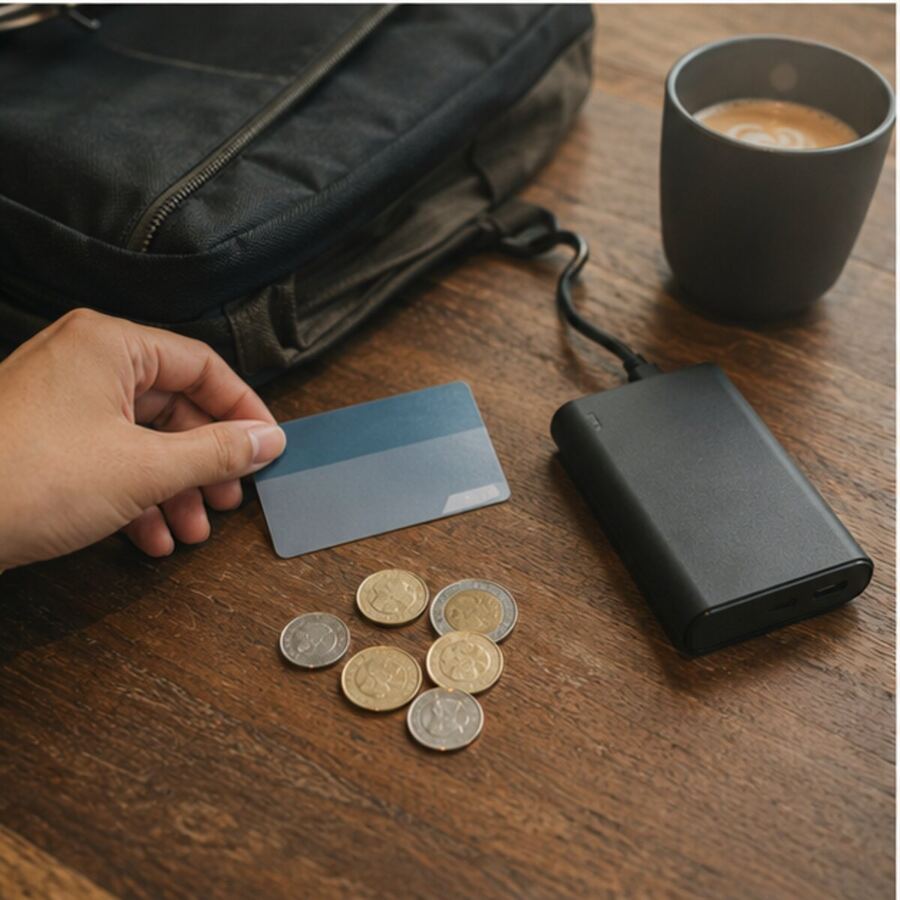
Create a small monthly equipment reserve for chargers, cables, adapters, battery wear, headphones and eventual power-bank replacement. You may spend nothing in a given month, but the reserve prevents an urgent replacement from breaking the budget. A reliable compact charger and charged power bank can also let you choose a better seat instead of competing for the only outlet. Do not treat café electricity as guaranteed. Arrive charged and ask before using sockets.
Security also has a cost. Use device encryption, updates and two-factor authentication; keep backups and consider a privacy screen if you handle sensitive information in public. The FTC explains that encrypted websites improve public Wi-Fi safety, but account security, fake sites and unattended devices remain concerns. A lost laptop or compromised account dwarfs a month of coffee. Never leave valuables to reserve a table. For high-risk work, budget for a private room, secure coworking space or mobile connection.
5. The expensive costs nobody puts in the spreadsheet
A failed session includes the first order, transport to the venue, time spent searching for a seat and the second journey to a backup. Track it. If one in five sessions fails because a fashionable café is full or does not allow laptops, the real cost per successful day rises sharply. Build a rotation of verified venues and check current hours and policies before leaving. A predictable chain café or coworking lobby can be the financially smarter backup even when it is less inspiring.
Over-ordering is another hidden cost. Remote workers sometimes buy food they do not want because they feel guilty, or visit premium cafés merely for the image. Set an honest session budget and choose venues where that spending feels fair. Under-ordering also carries a cost if it creates anxiety or poor etiquette. A sustainable plan aligns your purchase with the length of stay, the table demand and the value you receive. The goal is a repeatable relationship with venues, not extracting the maximum desk time from the minimum drink.
Decision fatigue has a price. Searching every morning, comparing maps and reacting to full rooms consumes focus. Use three default locations: a near-home focus café, a station-connected meeting café and a secure fallback. Preload routes and menus. This does not eliminate exploration; it protects your important work while leaving separate days for discovering new places. A stable rotation often reduces spending because you know which order, seat, travel time and backup work, and you stop paying for avoidable experiments during deadlines.
6. When coworking or a hybrid plan is cheaper
Compare cafés with the exact coworking product you would use: day passes for occasional calls, a weekly package for a sprint or a monthly desk for a stable routine. Include coffee, meeting rooms, printing, secure storage and the ability to take calls. Do not compare one cheap café drink with a full-service membership; compare a complete productive workday with another complete productive workday. If café spending, transport and failed sessions approach a membership price, the coworking option may buy reliability rather than luxury.
A hybrid schedule is often the best budget. Work at home for heavy production, use cafés for planning and creative variety, and buy coworking access for meetings or unreliable-power days. For example, twelve café sessions, four coworking days and home work can cost less than twenty-six full café days while improving output. The right mix depends on housing: a studio with a real desk changes the equation; a dark room with no ergonomic chair makes external workspace more valuable.
Review monthly with evidence. Add total café orders, transport, connectivity, coworking and equipment reserve; divide by productive hours. Note energy and wellbeing as well as money. Then adjust one variable: fewer long café days, a closer neighbourhood, a better home chair or a fixed meeting day. A useful Bangkok budget is not a punishment or an exact prediction. It is a tool that lets digital nomads enjoy the city’s café culture without quietly spending more, travelling farther or finishing less work than intended.

Frequently asked questions
Frequently asked questions
What is a reasonable monthly café-work budget?
Build it from your real number of days, current menu prices, return transport and session length. Light use can be a few thousand baht; intensive daily use with meals and transport can exceed ten thousand.
Is coworking cheaper than cafés in Bangkok?
It can be for frequent long days, calls or teams. Compare complete productive days and include failed café sessions, not just one drink versus a membership.
How can I reduce café-work costs?
Use a home–café–coworking hybrid, choose direct routes, keep reliable backups, track cost per productive hour and reserve cafés for tasks that benefit from the environment.