
Working from a Bangkok café for several hours: how to be a welcome guest
A practical guide to long café work sessions in Bangkok: permission, ordering, peak times, calls, tables, security, breaks and when coworking is fairer.
Quick answer
Ask whether a long laptop session is welcome, choose a table that fits your group and follow the café's ordering policy. Watch what is happening around you. A quiet morning and a full lunch service can call for different decisions at the same table.
What to ask before a long stay
| Your situation | Start with | Check before choosing |
|---|---|---|
| On arrival | Ask about laptop use and duration | Some tables or hours may differ |
| The café fills up | Follow staff guidance; reassess your stay | One drink is not an all-day pass |
| Need to take a call | Ask for an appropriate place | Headphones do not hide your voice |
Use this as a decision aid. Check the exact café, route and current terms before committing; examples are not live prices or reservations.

1. Permission comes before etiquette
Most awkward café-work moments are easier to avoid with one friendly question at the start. Tell staff roughly how long you hope to stay and whether you will need to take a call. They can point you towards a suitable table or explain a restriction before you settle in. You get a clearer plan, and the café does not have to interrupt you later to move a laptop, free a large table or deal with a cable across the floor.
Read the venue type. A small specialty bar with eight stools depends on turnover; a bakery needs lunch tables; a large all-day café may expect guests to stay. A hotel lobby, community space and chain branch operate differently. Do not judge generosity by room size alone. Some spacious venues reserve sockets or tables for dining, while compact places actively welcome workers during weekdays. Follow the latest staff guidance rather than assuming that buying an expensive drink purchases unlimited time.
Policies can change by day and hour. A café may allow laptops on weekday mornings but restrict them on weekends, during brunch or after a certain time. Wi-Fi passwords may expire, power may be limited and group meetings may need booking. Recheck a familiar venue after renovation or a long absence. Respecting updated rules is not a concession; it keeps the relationship predictable. If a policy no longer fits your work, switch to a different venue or coworking space without arguing that it used to be allowed.
Use the Café Finder's Stay & Work category to start your shortlist, then read each café's own conditions. NANA Ari and Lase Lase are current Ari examples to investigate, but a category label does not reserve a table or cancel the café's rules. If you need several conversations during the day, compare the Ari meetings guide before choosing a quiet reading spot.
2. Order in proportion to time and demand
There is no universal one-drink-per-hour law, but one small purchase rarely justifies occupying a valuable table through several busy meal periods. Use judgment. For a short session, one order may be natural. For two or three hours, consider another drink, food or dessert, especially when table demand rises. The point is not a rigid timer. It is to maintain a fair exchange with a business providing air-conditioning, toilets, cleaning, power, Wi-Fi and space while other customers may be waiting.
Order what you will actually consume. Buying unwanted food from guilt is not sustainable, and constant sugar or caffeine can damage the workday. Choose venues whose normal menu fits your budget and session. If you need lunch, use a café with substantial food rather than carrying outside meals without permission. Ask about water refills and kitchen closing time. A responsible long stay is easier when your needs align with the venue instead of requiring exceptions.
Watch the room. A nearly empty weekday café can support a longer stay with less impact; the same table may be needed at Sunday brunch. If a queue forms, finish the current block, order again if appropriate or move. Do not wait for staff to create a conflict. Plan an off-peak arrival and an exit trigger before sitting down. For example: leave at noon, after three hours, when the room reaches capacity or when the task changes to a call.

3. Use the right table and a compact setup
Use one seat and the smallest table that supports the work. Do not take a four-person table alone when counters or two-person tables are available, especially at meal times. Keep bags under the table, not on neighbouring chairs. Ask before moving furniture. A laptop, notebook, mouse and drink should fit without expanding across the room. External monitors, large stands and extension boards may be technically possible but socially inappropriate in a compact café. Choose coworking when the setup resembles a full office.
Keep cables safe. Never stretch a charger across a walkway or unplug café equipment. Ask whether a visible socket is available, and arrive with charged devices. A power bank reduces dependence on one desirable seat. Adjust the work to the furniture: low lounge tables suit reading and planning, not long typing; stools suit Quick Stop, not six hours. Ergonomic discomfort is a signal to leave or change task, not a challenge to endure because the café looks good.
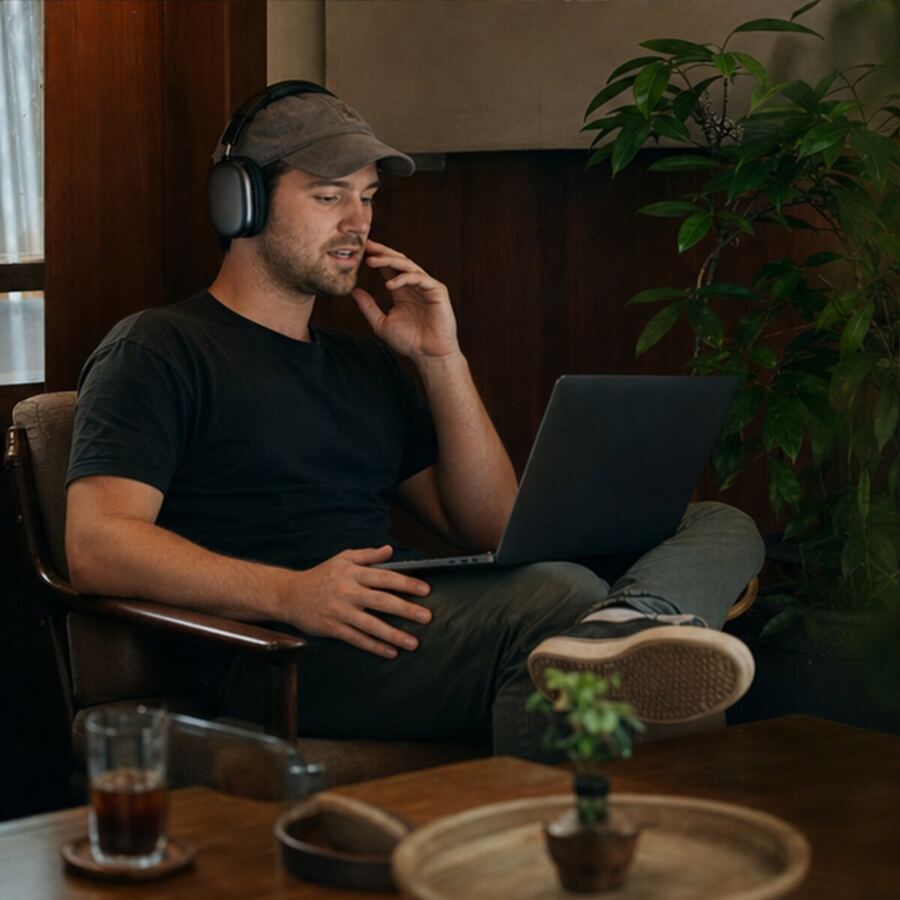
Manage sound from your side. Disable notification chimes, use headphones at low volume and avoid speakerphone. Mechanical keyboards, repeated voice messages and loud video playback affect the room. If you need to listen closely, closed-back headphones help without forcing high volume. Leave one ear aware enough for staff instructions and emergencies. Personal focus tools should reduce your footprint, not make everyone else adapt to it.
4. Calls, teams and privacy
A quiet café is usually the worst place for a call because your voice becomes the main noise. Ask whether calls are permitted and choose a conversational zone away from other laptop workers. Keep internal check-ins short, use a directional microphone and speak at normal volume. For sales calls, interviews, classes or workshops, book a phone booth or meeting room. Headphones control what you hear, not what everyone hears from you. If the call matters, uncertainty about etiquette is already a reason to use another space.
Teams should not arrive unannounced and merge tables. Confirm group size and whether conversation is welcome. Buy appropriate food and drinks, keep the meeting focused and avoid occupying the venue through a meal rush. Two people reviewing a document may fit Work Together; six people with laptops and a presentation do not belong in most cafés. A reservable room costs more because it provides the infrastructure and permission the team needs. That cost is part of doing the meeting professionally.
Protect privacy. Other customers can see screens, hear names and photograph the room. Use a privacy filter, position the laptop carefully and postpone confidential work. Lock the screen and carry valuables whenever you leave. Do not ask strangers to guard expensive equipment. Public Wi-Fi is only one risk; shoulder surfing and audible calls can reveal more. If your employer has a security policy, follow it even when the café feels familiar.
5. Breaks, toilets and leaving the table
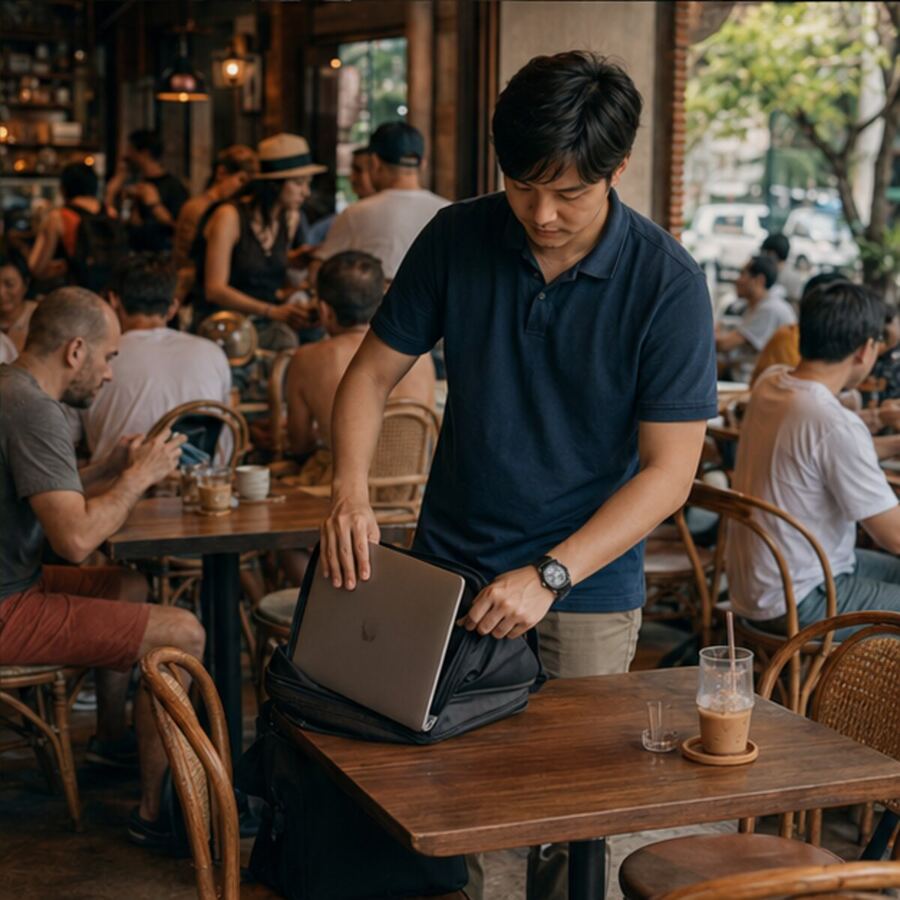
Confirm toilet access before a long session. Small shops may use a shared building toilet, require a key or have no customer facility. Plan breaks without treating the table as permanent storage. For a short toilet visit, take phone, wallet and passport, lock the laptop and ask staff only if their policy allows belongings to remain. For a longer meal, call or walk, pack up and release the seat. Leaving a laptop open does not convert a public table into a reservation.
Use movement as part of the plan. Stand every hour, change posture and take a short walk outside if weather permits. Long café sessions can look productive while creating neck, wrist and back strain. A second venue may refresh attention, but moving also costs time and another order. Decide before the day whether to use one three-hour block, two ninety-minute blocks or coworking for the whole day. The body is part of workability, not an afterthought.
Leave the space better than you found it. Return trays if the venue expects it, place rubbish correctly, clean obvious spills and tell staff about damaged sockets or furniture. Do not rearrange the room for photographs, record other customers or conduct commercial filming without permission. Thank staff when you have stayed a long time. These small behaviours reduce friction and make it easier for cafés to continue welcoming laptop users rather than imposing broad restrictions after repeated problems.
6. When an all-day café plan is the wrong plan
Choose coworking when you need six to eight hours of continuous work, several calls, confidential material, guaranteed power or a large setup. Choose a library-like space when silence matters and the rules allow your work. Choose home when the task needs maximum control and you already have a suitable desk. A café is not a cheaper coworking space by definition. It is a hospitality business with a different promise. Respecting that distinction reduces conflict and usually improves your own concentration.
Leave early when a non-negotiable fails: the internet becomes unstable, the room fills, staff announce a policy, noise changes or your body becomes uncomfortable. Sunk cost is not a reason to protect a bad session. Keep one backup in the same station area and pre-download essential files. If the venue closes unexpectedly or no longer exists, verify before travelling and update your saved list. A calm move after ninety minutes is better than four hours of frustration.
A sustainable all-day routine is usually not all day in one café. It may be a focused morning at home, lunch and ninety minutes in a café, then a coworking call. Or it may be a three-hour café block followed by errands and an evening home session. Use external space for the part of work it improves. When you match time, task, purchase and venue, café work feels lighter for you and fairer for the people running the room.
Frequently asked questions
Frequently asked questions
How long is it okay to work in a Bangkok café?
There is no universal limit. Follow the venue's rule, order fairly, watch demand and ask if you expect more than one or two hours.
Should I buy another drink?
For a longer stay, especially when demand rises, another order is usually considerate. Choose a venue and schedule that make the exchange sustainable.
Can I leave my laptop while I use the toilet?
It is safer to lock it, take valuables and follow staff guidance. Never leave a device for a long break or ask strangers to guarantee its security.