
Working around Bangkok by BTS and MRT: a café day that is easy to follow
Plan a reliable Bangkok workweek by rail: routes, interchanges, station exits, café selection, rain, fares, mobile backup and sample workday patterns.
Quick answer
Pick the café, check its station and exit, then allow time for the walk and setup. Keep one nearby alternative. You do not need to master the whole rail map to plan a good day; you need a clear route for the places you will actually visit.
A café day in four steps
| Step | Start with | Check before choosing |
|---|---|---|
| 1 | Pick one café that fits the task | Facilities, opening hours, exact branch |
| 2 | Choose the station and exit | Compare primary and alternative approaches |
| 3 | Allow time to walk and set up | Rain, crossings, ordering and network |
| 4 | Keep one useful backup | Its hours and route must fit too |
Use this as a decision aid. Check the exact café, route and current terms before committing; examples are not live prices or reservations.
1. Build a two-layer Bangkok work map
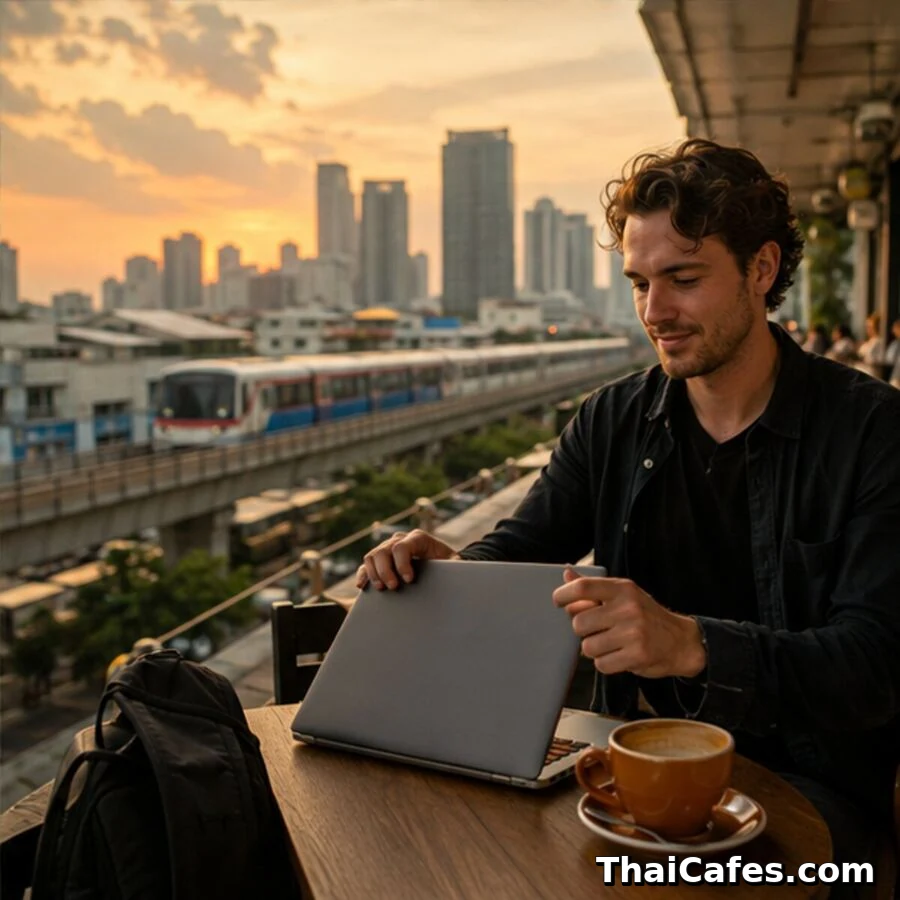
Bangkok gets much easier to navigate when you stop trying to fit the whole city into one day. Choose a work café near the route you already need, rather than crossing town for every recommendation. The train is only part of that journey: the exit, street crossing and café entrance can change how convenient it feels. Save the route before leaving and give yourself enough time to arrive without opening the laptop in a hurry.
Choose three anchors: a near-home focus café, a central meeting venue and a fallback that is weather-proof. Add one coworking option for important calls. Save exact station, line, direction, exit, walking route, opening hours and current laptop policy. Do not save only a map pin. Large stations can have exits on opposite sides of roads, and a straight-line distance ignores platforms and crossings. A prepared route turns a city of choices into a small, repeatable system.
Use ThaiCafes station filters to shortlist by actual rail order, then apply work-mode filters. Read the café page for walking time, Work Score, official channels and current context. Verify before travel because businesses close, hours change and laptop rules evolve. If a place no longer appears on current maps or is permanently closed, remove it from the active route. Reliable curation is a living system, not an archive of every café ever posted online.
Ari makes a useful first example. You can compare its station page with Sanam Pao and choose the shorter approach to Hungry Brown or Lase Lase. The Ari exit guide keeps the routes separate, and the one-day Ari plan shows how to combine a main work block with a meal without visiting every café on the list.
2. Understand BTS, MRT and interchanges
BTS provides a clear elevated spine through Sukhumvit, Siam, Ari and the Silom–Sathorn corridor. It is intuitive for many visitors and often connects to malls, offices and skywalks. MRT reaches a broader loop through Sukhumvit, Silom, Sam Yan, the old-town edge, western Bangkok, Bang Sue, Chatuchak, Lat Phrao, Ratchada and Rama 9, while Purple, Yellow and Pink lines extend the practical map. Neither is universally better. The best route is the one aligned with your repeated destinations.
Interchanges expand options but cost time. Asoke–Sukhumvit is powerful for central access, Sala Daeng–Si Lom for CBD, Mo Chit–Chatuchak Park for the north and Ha Yaek Lat Phrao–Phahon Yothin for another north-side connection. The walk between systems is not always immediate or fully sheltered. Test it during your actual travel period with a laptop bag. Two transfers can make a theoretically central route tiring, especially when escalators, queues and wrong exits compound.
Payment and fare integration change, so use official operator information rather than old travel blogs. Calculate each regular origin–destination pair and keep a backup payment method. Do not assume one ticket or contactless card works across every segment. For a monthly estimate, multiply real return fares by expected days and add last-mile transport. The financially cheapest home may not create the cheapest workweek once transfers, motorcycle taxis and travel time are included.
3. Navigate station exits and the last mile
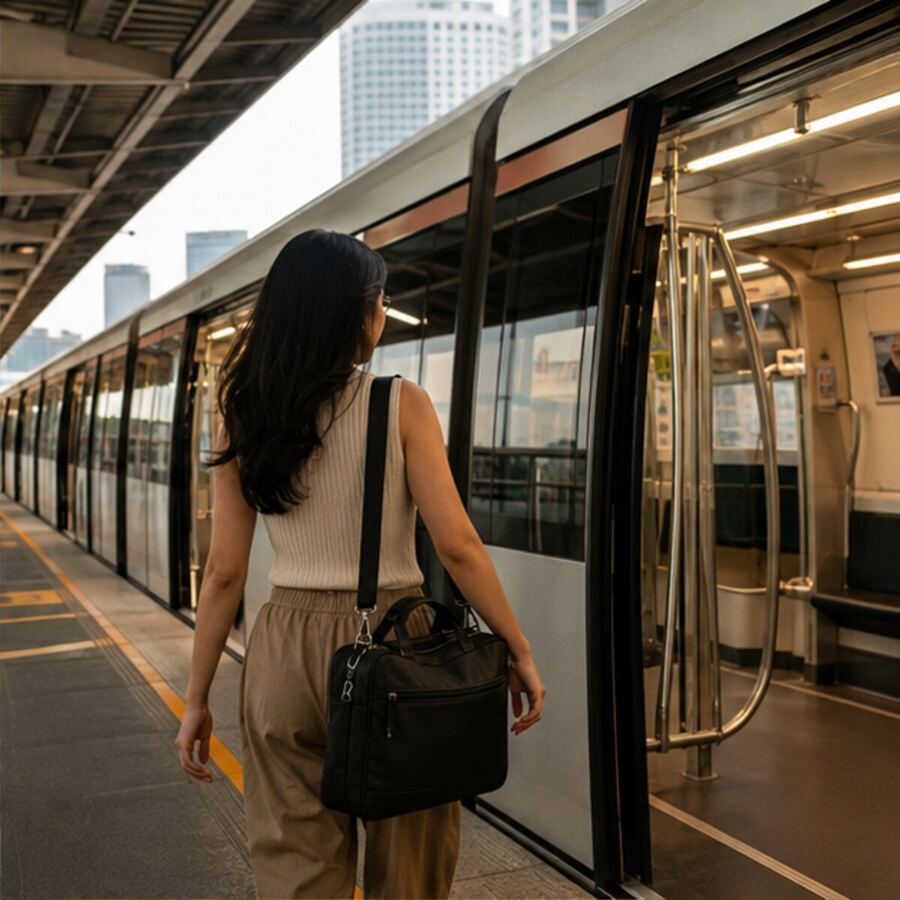
The correct exit can save more time than one fewer train stop. Save the exit number and which side of the road it reaches. Note lifts, footbridges, skywalks and underground passages. At MRT stations, the platform-to-street journey can be long; at BTS stations, stairs may be exposed. A café advertised as seven minutes away may require a difficult crossing or deep soi. Check the walking route in street view, then verify it once in person.
Bangkok weather changes last-mile quality. Midday heat increases fatigue; storms can flood paths and expose devices. Save a normal route and a rain-safe route, possibly through a mall or office complex. Check Thai Meteorological Department forecasts before a day with long exposed walking. Carry a compact umbrella or waterproof laptop sleeve, but do not assume gear fixes every route. Moving the meeting to a connected building may be more professional than arriving soaked and overheated.
Budget the last mile explicitly. Regular motorcycle taxis, ride-hailing and shuttles can exceed rail fares. Walking is free in cash but not in time or energy. Compare a café inside a connected complex with one deeper in a soi by total productive cost. For Quick Stop, direct access often wins. For Deep Focus, an extra eight-minute walk may be worth it if the room is quieter. The work mode decides whether last-mile friction buys a useful environment.
4. Plan sample workdays by corridor
A northern BTS day might begin with Deep Focus in Ari, use lunch before the peak, then continue to Siam or Asoke for a meeting without changing lines. A Silom day can combine a morning café near Chong Nonsi, a client meeting around Sala Daeng and a screen break in Lumphini Park. An MRT day can pair Sam Yan research with Rama 9 meetings or Huai Khwang evening food. Grouping by corridor protects the work block from cross-city movement.
A western or old-town day should include more buffer. MRT extensions and boats open distinctive areas, but last-mile timing and tourist crowds vary. Use creative offline work on the journey and schedule one anchor, not three tight appointments. An outer-line day around Nonthaburi, Srinagarindra or Ram Inthra works best when several tasks sit in that corridor. Do not travel to a distant café only for its image on a high-stakes deadline. Treat exploration as a separate, low-risk work mode.
Set travel boundaries. For example, no more than one interchange before noon, no meeting across the city within ninety minutes of a focus block, and no new venue for a paid call. These rules reduce decision fatigue. They are not permanent; adjust after observing real travel. A well-designed week may visit fewer neighbourhoods yet deliver more work. The rail network supports freedom when it creates reliable options, not when every day becomes a transport challenge.
5. Carry a rail-ready work kit and backup plan
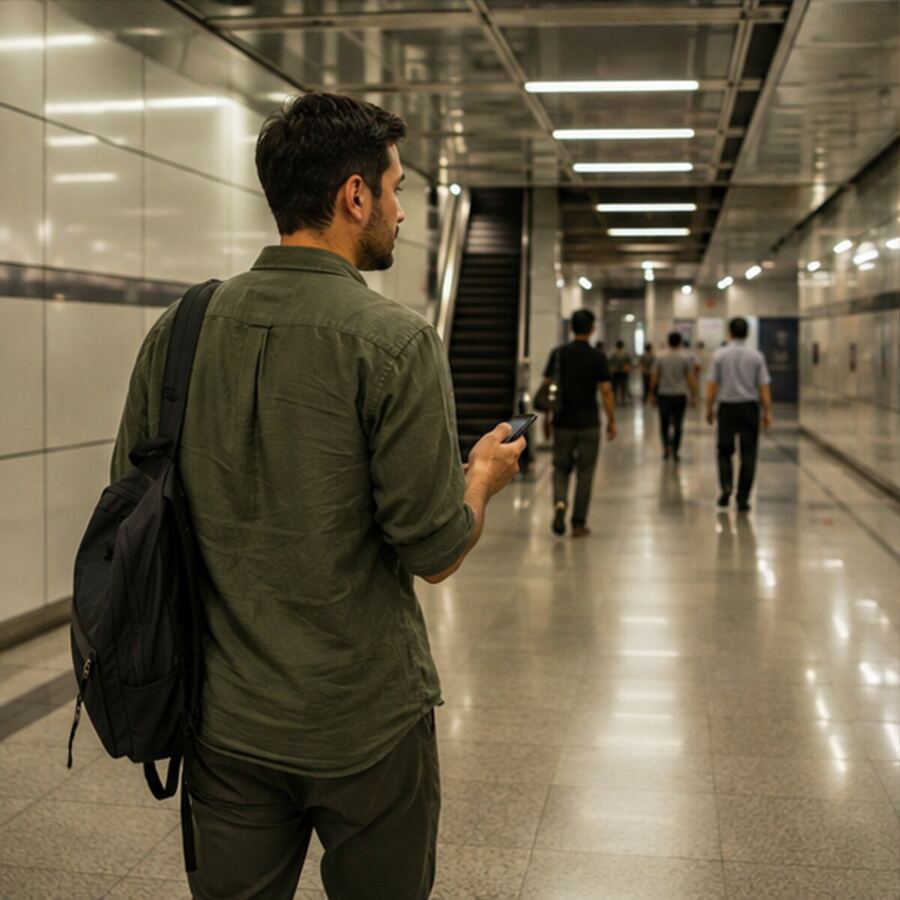
Keep the bag light enough for stairs and transfers: laptop, phone, headphones, compact charger, power bank, tested cables, notebook and weather protection. Download maps, work files and meeting links. Heavy stands and multiple peripherals can make a ten-minute interchange exhausting and encourage you to occupy more café space. If the work truly needs a large setup, use home or coworking. Mobility works when packing and moving take minutes, not a quarter of the day.
Use café Wi-Fi for ordinary work and a local SIM/eSIM hotspot as backup. Test mobile signal at the seat, not only outside. Arrive charged and ask before using power. For an important call, choose a bookable room and join early. Save one alternative in the same station or connected complex. If the first place is closed, full or no longer permits laptops, switch without re-planning Bangkok from zero.
Create a failure script: save locally, message collaborators, switch internet, move if necessary and update the plan. Keep valuables with you and lock the screen. If a train disruption or storm affects the route, use the near-home anchor instead of forcing the city crossing. Resilience often looks like doing less travel, not finding a complicated workaround. A backup is good when it preserves the work outcome, even if the day becomes less interesting.
6. Review the system every two weeks
Track trips, transfers, door-to-door time, café spend, productive hours and failed sessions. Note which station exits were confusing and which venues changed by time of day. After two weeks, identify one route to simplify and one workspace to replace. This evidence is more useful than collecting more recommendations. A route that repeatedly begins late is a design problem, even if every individual location has good reviews.
Recheck live information. Operators adjust fares, payment and services; cafés change hours, rules, names and status. Use official BTS and MRTA sources for routes and fares, operator pages for connectivity plans, and official café channels for venue facts. Treat creator videos as useful atmosphere and context, not the sole authority for current operations. Date your notes. A recommendation without a checked date becomes less reliable in a fast-changing city.
Then allow exploration back into the plan. Keep four reliable anchors for work and one flexible afternoon for a new station, café or attraction beyond the rails. If it performs well, promote it into the rotation. This balance supports ThaiCafes’ purpose: helping people discover Bangkok while still making good work decisions. The best digital-nomad rail guide is not a marathon itinerary. It is a repeatable system that leaves enough energy to work, meet people and enjoy the city after the laptop closes.

Frequently asked questions
Frequently asked questions
How many Bangkok workspaces should I save?
Start with three: near-home focus, central meeting and weather-proof backup. Add one coworking option for important calls.
Should I choose BTS or MRT first?
Choose the corridor that connects your repeated weekly destinations with the fewest difficult transfers; the brand is secondary.
What is the biggest Bangkok rail-work mistake?
Optimizing train time while ignoring exits, last-mile walks, weather, café rules and the need for a nearby backup.
Official sources & further reading
- BTS Skytrain — routes, fares and area maps ↗
- Mass Rapid Transit Authority of Thailand — MRT routes ↗
- Mass Rapid Transit Authority of Thailand — fares ↗
- Thai Meteorological Department — forecasts and warnings ↗
- US Federal Trade Commission — public Wi-Fi safety ↗
- dtac — official Thailand tourist SIM and eSIM plans ↗
- True-dtac — official Thailand tourist SIM and eSIM plans ↗